Author: Alan Dyer / SkySafari Premium / @AmazingSkyGuy (X)
The full Moon on the night of August 30 is bound to get a lot of attention. It's a "blue Moon" that's also a "supermoon". Pity there's no lunar eclipse as well!
The August 30 Moon is the full Moon closest to Earth and so the largest for 2023, winning it the popular moniker of a supermoon. But the August 30 Moon is also the second full Moon of August, as we also enjoyed a full Moon on August 1, when I shot the image above.
In recent decades, a second full Moon in a month has become popularly known as a blue Moon. Because the Moon takes 29.5 days to go from full back to full phase, we can sneak two full Moons into a 31-day month, provided the first one occurs on the first day of the month.
Blue moons by that definition occur about once every two and a half years, so they aren't particularly rare, certainly not as infrequent as the phrase "once in a blue Moon" would have you believe. By comparison, supermoons are annual affairs. Every year has one full Moon that is closer than all the others, with full phase coinciding with perigee, when the Moon is closest to Earth in its monthly elliptical orbit around us.
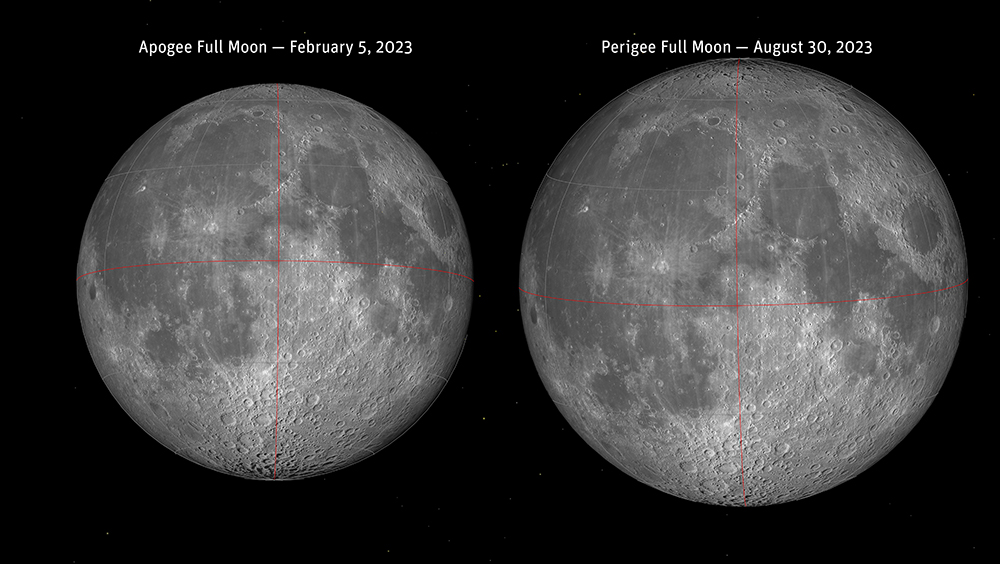
The opposite, which I show in the comparison above, is a full Moon that coincides with apogee, when it is farthest from Earth. The February 5 full Moon was the most distant and smallest of 2023. I think only one Moon deserves the title of supermoon each year, but I'm afraid the popular press thinks otherwise.
Each year, two to four full Moons win the designation, applying a more generous definition that a supermoon is any full Moon within 90% of the minimum distance to Earth.
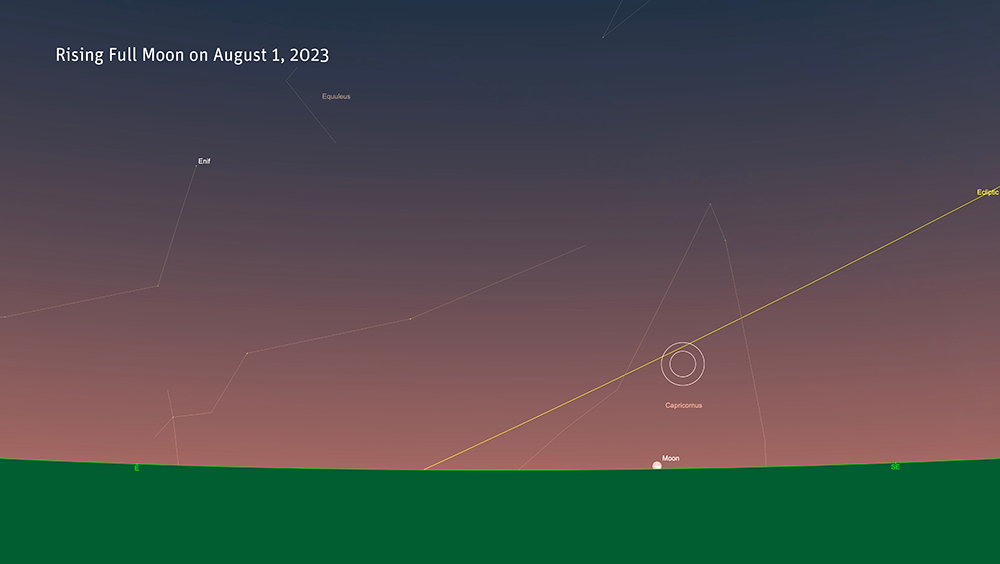
By that loose definition the full Moon of August 1 (shown at moonrise above in SkySafari) was also a supermoon, just not quite as "super" as the one that ends the month. On August 1, the Moon's minimum distance was 357,310 km vs. 357,181 km on August 30. So the differences are slight.
As shown below, on August 30 the Moon will rise more to the north than it did at the beginning of the month, a progression along the horizon that is opposite to what the Sun does, as its sunrise point moves south during late summer and autumn.
On August 30, the rising Moon also appears close to Saturn, then just three days past its opposition point. So, like the full Moon, Saturn rises at sunset. (The concentric circles mark the location of Earth's shadow, and the place in the sky that lies directly opposite the Sun.)

So we have a super blue Moon! Will it look blue? No. Will it look big? Perhaps, but the difference in apparent size between a super- and an average-size Moon is only 7%, or 14% larger than a minimum-sized apogee Moon. That's enough to notice if you had the two Moons side by side, as I show at top. But without that ready comparison, the unaided eye can't really tell if the Moon is bigger. Though people will certainly think it is.
To see an animation of the Moon's changing size through the year, open this story in SkySafari's Tonight panel. The link provided in this section will take SkySafari to February 1, 2023 in a close-up framing of the Moon. Step time ahead by the day to watch the Moon wax to full on February 5, the most distant full Moon of 2023. Keep stepping ahead by the day to watch the Moon not only wax and wane through its monthly phases, but also grow and shrink in size each month, reaching its maximum size for a full Moon on August 30. You'll also see the Moon wobble on its axis, a motion called "libration" that SkySafari accurately simulates.
While it won't appear blue, the Moon that rises on August 30 will nevertheless look impressive. It will be worth the effort to find a location with a clear horizon to the southeast to watch the rising of the "blue supermoon" of 2023.